Kentico pricing starts at about $990 per month for a self-managed Xperience by Kentico license and goes up to over $22,300 per year for enterprise-level Kentico Xperience 13 deployments, with SaaS plans costing more when cloud hosting and support are bundled in. The actual number for your project will vary based on license tier, channel count, hosting model and how much custom development the build requires. This guide will take you through each layer of Kentico cost so you can budget accurately before you talk to a vendor.
How Much Does Kentico Cost in 2026?
How Much Does Kentico Cost in 2026?
Kentico cost falls into three buckets: the license fee, the hosting or SaaS subscription, and implementation services. Third-party pricing trackers report Kentico Xperience 13 Business starting near $12,500 a year and Enterprise starting near $22,300 a year, while the newer Xperience by Kentico platform lists self-managed licensing from about $990 a month and SaaS plans from roughly $1,990 a month.
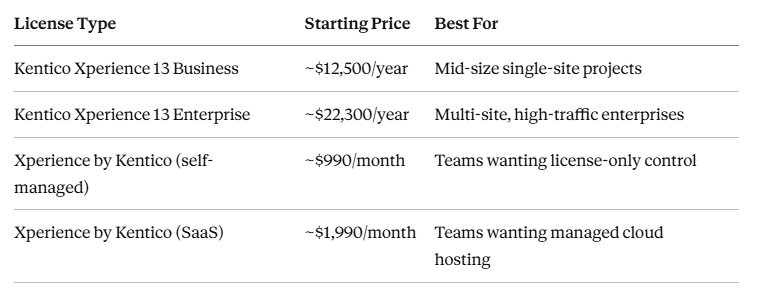
A few things push the number up or down:
Number of web, email, and headless channels you need standard versus Advanced license tier Whether you buy channels upfront (cheaper per channel) or add them later AIRA AI credit package for content generation and personalization Cloud level for SaaS deployments.What Is the Difference Between Kentico CMS Pricing and Kentico Kontent Pricing?
Kentico CMS pricing and Kentico Kontent pricing cover two different product lines, and mixing them up is the most common budgeting mistake teams make. Kentico CMS (now Xperience by Kentico) is a full digital experience platform with a built-in content editor, page builder, and marketing tools, licensed by channel.
Kontent, the headless-only product, was spun off years ago and now operates independently as Kontent.ai with its own subscription pricing based on content items and users, unrelated to Kentico's current licensing model.
If a vendor quotes you "Kentico Kontent pricing" for a project involving Xperience by Kentico, ask for clarification. They are not the same product, and the pricing structures don't overlap.
How Is Kentico License Pricing Structured?
Kentico license pricing is based on a channel model, not per user or per server fees. Buy a platform license with a primary channel and add web, email, or headless channels as your digital footprint grows.Key structural points:
Main channels are full websites, email domains, or headless endpoints with no limits on admin users or visitors. Microchannels are miniaturized channels for microsites or sub-brand pages, less expensive but lower volume of content, not features. Standard tier is a single website with core CMS functionality.Advanced tier unlocks multi-channel support, AI content tools, and campaign management. Channels bundled with the initial purchase cost less per channel than ones added later, so upfront planning saves money over time.
This differs sharply from CMS platforms that charge by server count or contributor login, which is a licensing model several enterprise Kentico users on review platforms have flagged as a source of unpredictable cost with competing DXPs.
How Much Does a Kentico CMS Upgrade Cost?
Kentico CMS upgrade cost typically ranges from a few thousand dollars for a straightforward version bump to well over $50,000 for a full migration from an on-premise Kentico Xperience 13 instance to Xperience by Kentico's SaaS architecture. The spread is wide because "upgrade" covers everything from patching to a ground-up platform migration.
Why Kentico upgrades vary so much in cost |
kentico pricing
- Codebase age – Sites still on Kentico 8–12 need more remediation work than those already on 13/.NET Core.
- Custom modules – Heavily customized solutions require manual retesting and rewriting against the new API.
- Content volume – Large multi-site, multilingual installations take longer to migrate and validate.
- Integration count – CRM, ERP, and marketing automation integrations each need their own testing pass.
- Target architecture – Moving to headless or SaaS adds infrastructure work beyond a like-for-like upgrade.
Kentico Xperience 13 support is scheduled to end in 2026, which makes this upgrade a compliance and security issue, not just a feature decision, for anyone still running it.
Kentico Xperience 13 vs. Xperience by Kentico: cost comparison
FactorKentico Xperience 13Xperience by KenticoLicense modelPer-instance annual licensePer-channel platform licenseStarting price~$12,500/year (Business)~$990/month (self-managed)HostingSelf-managed or partner-hostedSelf-managed or Kentico SaaSRelease modelPeriodic major versionsEvergreen, monthly updatesAI featuresLimited/noneAIRA agentic suite (credit-based)Support after 2026EndingActively maintained
What Drives Total Kentico Development Cost?
Kentico development cost is the license fee plus everything needed to design, build, and launch the site on top of it. Implementation typically costs more than the license itself for mid-to-large projects.
Cost drivers include:
-
Design complexity and number of unique page templates
-
Custom module or API development
-
Data migration from a legacy CMS
-
Third-party integrations (CRM, payment gateways, marketing tools)
-
QA, accessibility testing, and performance tuning
-
Ongoing maintenance and support retainers
A three-year total cost of ownership for a mid-size Kentico Xperience deployment, including licensing, implementation, training, and hosting, commonly lands somewhere between $50,000 and $300,000 depending on project scope and how much customization the build requires.
What Hidden Costs Should You Budget for Beyond the License?
Kentico's license fee only covers the software. Most project budgets underestimate the surrounding costs, which is where a quoted "Kentico cost" and the actual invoice start to diverge.
Commonly missed line items:
- Implementation and development. Design, templating, and custom build work, often billed separately by an agency or partner.
- Data migration. Moving content, users, and media from a legacy CMS, including cleanup of broken links and outdated assets.
- Training. Onboarding content editors and marketers on the new interface, especially after a major version change.
- Renewal increases. Annual license renewals often rise, so lock in multi-year terms where possible if pricing stability matters to your budget.
- Cloud resource upgrades. SaaS customers who exceed pageview, storage, or email-sending limits pay for resource tier upgrades.
- AIRA credit consumption. AI features run on a consumption-based credit model separate from the base license, so heavy AI usage adds a variable monthly cost.
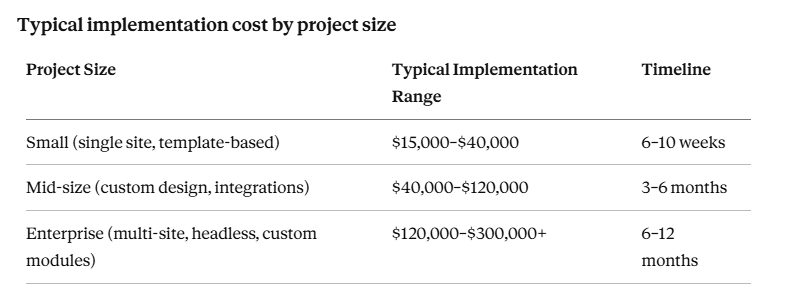
Typical implementation cost by project size
Project SizeTypical Implementation RangeTimelineSmall (single site, template-based)$15,000–$40,0006–10 weeksMid-size (custom design, integrations)$40,000–$120,0003–6 monthsEnterprise (multi-site, headless, custom modules)$120,000–$300,000+6–12 months
These ranges cover implementation only and sit on top of the annual license or SaaS subscription fee.
Is Kentico Cost-Effective Compared to Competitors?
Kentico generally costs less than top-tier enterprise DXPs like Sitecore while delivering comparable functionality, according to feedback from verified users on independent review platforms. One enterprise developer reviewing the platform on TrustRadius described Kentico as delivering roughly the bulk of a premium CMS's functionality at a fraction of the price of higher-end competitors.
However, cost-effectiveness depends on the scale of the project: Licensing can sometimes be steep for smaller organizations compared with lighter open source options. More often than not, mid-market and enterprise teams say they save development time that can offset the license cost. If you have to buy a bunch of add-on modules to get features that are available natively somewhere else, then heavy customization can eat away at the price advantage.
How Can You Reduce Kentico CMS Upgrade Cost?
It’s not all or nothing: You can meaningfully reduce Kentico CMS upgrade cost by controlling scope, timing and vendor selection.
Practical ways to cut cost:
Audit before you scope. Identify which custom modules are still needed versus ones native features now replace.
Migrate content in phases. Move high-traffic sections first and archive or redirect low-value legacy pages instead of migrating everything.
Buy channels upfront. Bundled channel purchases cost less per channel than adding them piecemeal later.
Work with a Kentico Gold Partner. Partners with migration experience avoid rework that inflates hourly billing.
Reuse design systems. Rebuilding on existing brand components instead of a full redesign shortens the timeline significantly.
Time the move before the support deadline. Migrating ahead of Kentico Xperience 13's end-of-support date avoids emergency-timeline premiums.



.webp?lang=en-US&ext=.webp)

.webp?lang=en-US&ext=.webp)