The point is simple.
A multilingual healthcare chatbot is not just “nice tech.”
It is a practical tool to reduce friction, save staff time, and help patients feel understood.
If you are thinking about building or upgrading one, you can work with an AI chatbot development company or build in‑house, but in both cases, the real value comes from how well the bot fits your workflows and your patients’ real questions.
Key takeaway
It should talk to patients in the language they are most comfortable with.
It should answer common questions quickly and correctly.
And it should guide them to the next safe step, whether that is booking, calling, or self‑care.
If your solution does those things clearly, you are already ahead of many providers still relying only on phone trees and long FAQs.
What is a multilingual healthcare chatbot?
A multilingual healthcare chatbot is a digital assistant that chats with patients in multiple languages on your website or app. It can understand questions, reply in the selected language, and trigger basic workflows such as booking, triage questionnaires, or information lookups.
Usually, it uses AI models for language understanding and translation, combined with your own medical content, policies, and workflows. The chatbot can either be purely text‑based or support voice, depending on where it runs and who your audience is.
The point is: this is not just a “chat widget.”
It is a way to make your digital front door open for people who do not speak perfect English or who feel anxious using traditional channels.
Why multilingual chat matters in healthcare now
A multilingual healthcare chatbot is a digital assistant that chats with patients in multiple languages on your website or app. It can understand questions, reply in the selected language, and trigger basic workflows such as booking, triage questionnaires, or information lookups.
Usually, it uses AI models for language understanding and translation, combined with your own medical content, policies, and workflows. The chatbot can either be purely text-based or support voice, depending on where it runs and who your audience is.
The point is: this is not just a “chat widget.”
It is a way to make your digital front door open for people who do not speak perfect English or who feel anxious using traditional channels.
Why multilingual chat matters in healthcare now
Language gaps in healthcare are not a minor issue. Studies show tens of millions of people in the US speak a language other than English at home, and around 8% or more are considered to have limited English proficiency, which is linked with worse health outcomes and more confusion in care. That means a large share of your potential patients may struggle to understand clinical instructions, insurance details, or even basic appointment information.
At the same time, AI-powered virtual assistants are becoming mainstream in healthcare service operations and patient engagement. Industry research shows healthcare organizations are turning to AI agents to handle routine questions, coordinate tasks, and support patient journeys across channels. When you combine the pressure on staff with the rising demand for digital self-service, the timing for multilingual chatbots is obvious.
So the real question is: when a worried patient lands on your site at 10 p.m., in their second language, will they find a friendly chat that “speaks” to them—or a wall of text that pushes them back to the phone line tomorrow?
Improve customer (patient) experience with AI chatbots
Patients do not care about the technology behind your site. They care about feeling heard and getting help quickly. A multilingual chatbot improves that experience in a few simple but powerful ways.
It answers common questions instantly
Patients can ask about clinic hours, doctor availability, test preparation, or insurance coverage, and get clear answers in their preferred language without digging through multiple pages.
It guides them step by step
Instead of giving generic links, a good chatbot asks quick follow-up questions and then guides the patient to the right action—book an appointment, upload a document, or call a specific number.
It reduces frustration and anxiety
When people are worried about their health, repeating information or misunderstanding instructions feels exhausting. A multilingual chatbot reduces that emotional load by communicating in familiar words and breaking steps into small, clear pieces.
Why it hurts:
- When patients cannot easily understand your digital channels, they either avoid care, clog phone lines, or show up unprepared.
- None of those options help your staff or your outcomes.
Key benefits of a multilingual healthcare chatbot
.png "Key-benefits-of-a-multilingual-healthcare-chatbot-(2).png")
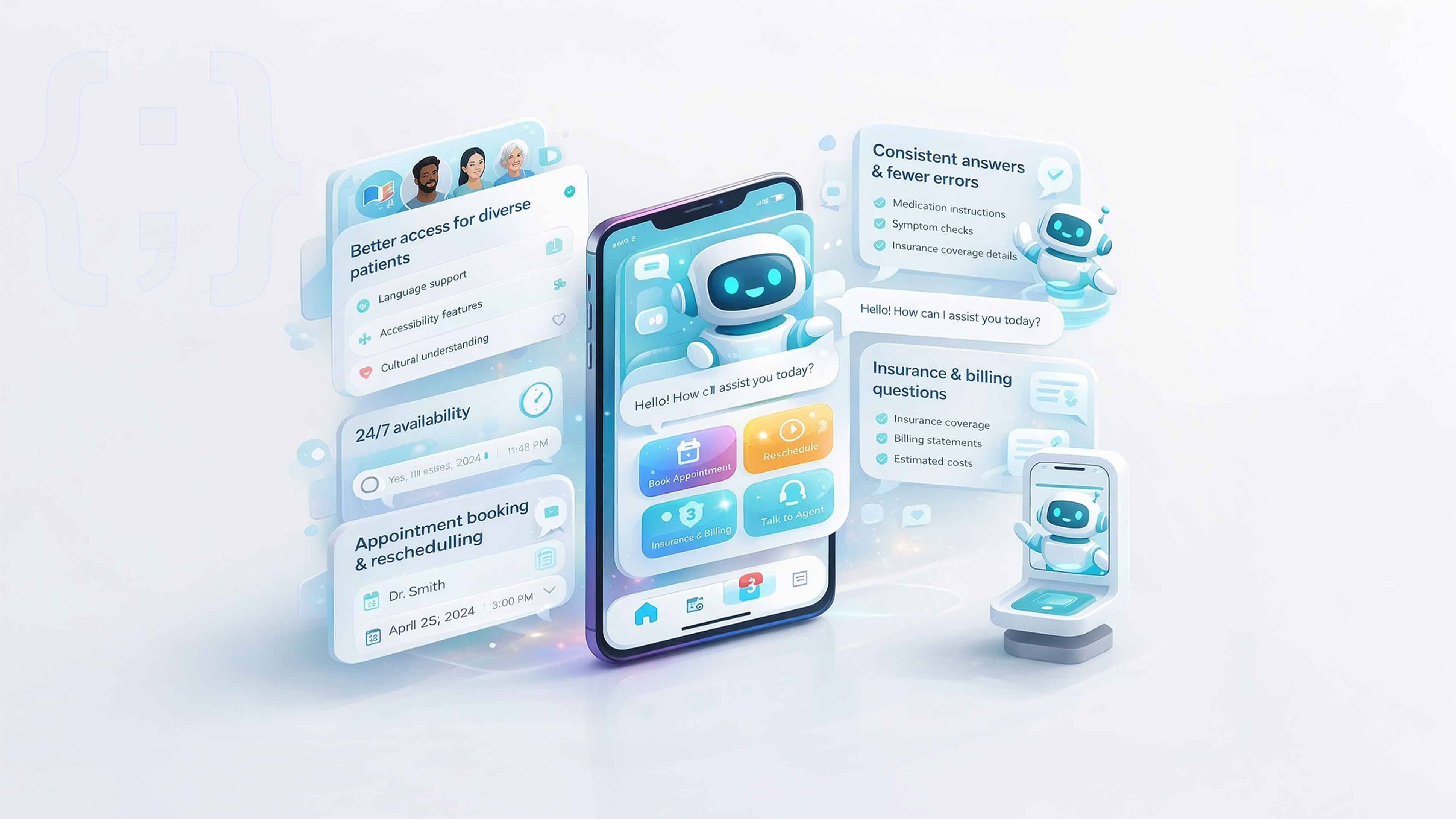
1. Better access for diverse patients
A multilingual chatbot gives equal access to information and support for patients who are not fluent in English. This can help close gaps where language barriers create confusion about follow-up, medications, or insurance rules.
It also builds trust. When patients see their language, they feel that the provider actually “sees” them, which encourages them to ask questions instead of staying silent.
2. Reduced pressure on staff and call centers
Every healthcare team knows the pain of repetitive calls. “What are your hours?” “Can I reschedule?” “Is this symptom urgent?”
AI chatbots can handle a large share of these questions, freeing staff to focus on complex cases, in-person interactions, and clinical work that actually needs a human.
If designed well, the chatbot becomes a first filter that either solves the issue or collects enough context so a human agent can step in quickly.
3. Consistent answers and fewer errors
Humans get tired, rushed, or distracted. Chatbots do not.
When you embed your approved medical content, policies, and FAQ into the chatbot, it can provide consistent answers every time. This is especially useful for things like pre-op instructions, billing rules, or insurance documents that must be explained carefully.
The point is not that the bot replaces clinicians.
The point is that it keeps routine information accurate and repeatable.
4. 24/7 availability
Patients search for answers at all hours, especially if they are anxious or in pain. Chatbots can offer basic guidance around the clock, even when your clinics are closed.
This does not mean the bot gives medical diagnoses or treatments by itself. It means it can suggest safe next steps, such as “Call this number now,” “Visit urgent care,” or “Book the next available slot.”
5. Rich data for better decisions
Every chat is a signal. What are people asking about most? Where do they get stuck? Which languages show the highest drop-off rates?
With a multilingual chatbot, you can see patterns in patient questions and behavior and adjust your content, services, or staffing accordingly. This is where the business value becomes clear.
Common use cases for multilingual healthcare chatbots
Use case 1: Appointment booking and rescheduling
Patients can ask the bot to find a doctor, check available time slots, and book or reschedule appointments without calling the front desk. The chatbot can show available options, confirm details, and push updates to your scheduling system.
A multilingual approach is especially useful for older patients or those who prefer simple conversational steps over complex forms.
Use case 2: Pre-visit and post-visit instructions
A chatbot can share preparation steps, fasting rules, document checklists, and post-procedure care instructions in multiple languages. This helps reduce no-shows, repeat calls, and misunderstandings about what to do before or after a visit.
The point is: when instructions are clear and in a language the patient understands, adherence tends to go up, and risk tends to go down.
Use case 3: Symptom check and triage support (within safe limits)
Some providers use chatbots to run basic triage questions and suggest safe next steps, such as “call emergency”, “book a telehealth visit”, or “monitor and follow up later”. These tools must follow strict clinical guidelines and should always include disclaimers and escalation paths to human nurses or doctors.
However, the problem is when organizations expect the chatbot to “replace” clinical judgment. It should help route and inform, not diagnose on its own.
Use case 4: Insurance and billing questions
Billing and insurance confuse almost everyone. A multilingual chatbot can explain coverage basics, claim status, copay information, and payment methods in plain language.
By answering repetitive billing questions, the bot reduces both patient frustration and call center load.
Use case 5: Patient education and self-care content
Chatbots can share curated articles, videos, and FAQs based on the patient’s questions and profile. For example, a person asking about hypertension could receive content about diet, exercise, medication reminders, and follow-up visits in their preferred language.
This keeps education practical and timely instead of burying people under generic links.
Can AI chatbots really answer questions and solve issues on websites and apps?
Yes, they can—within a clear scope. AI-powered chatbots on healthcare sites and apps are already handling thousands of daily interactions across symptoms, appointments, directions, portal login help, and more.
The key is to define what the bot should and should not do. For example:
- It can answer FAQs and policy questions.
- It can walk through structured flows like booking or rescheduling.
- It can help with navigation (where to click, which department to choose).
- It can collect basic details before handing off to a human.
But for clinical decisions, emergencies, and complex cases, the chatbot should escalate to humans right away and clearly tell the patient what to do next. That balance keeps things safe and reliable, while still taking pressure off staff.
How to implement a multilingual AI chatbot on a healthcare website
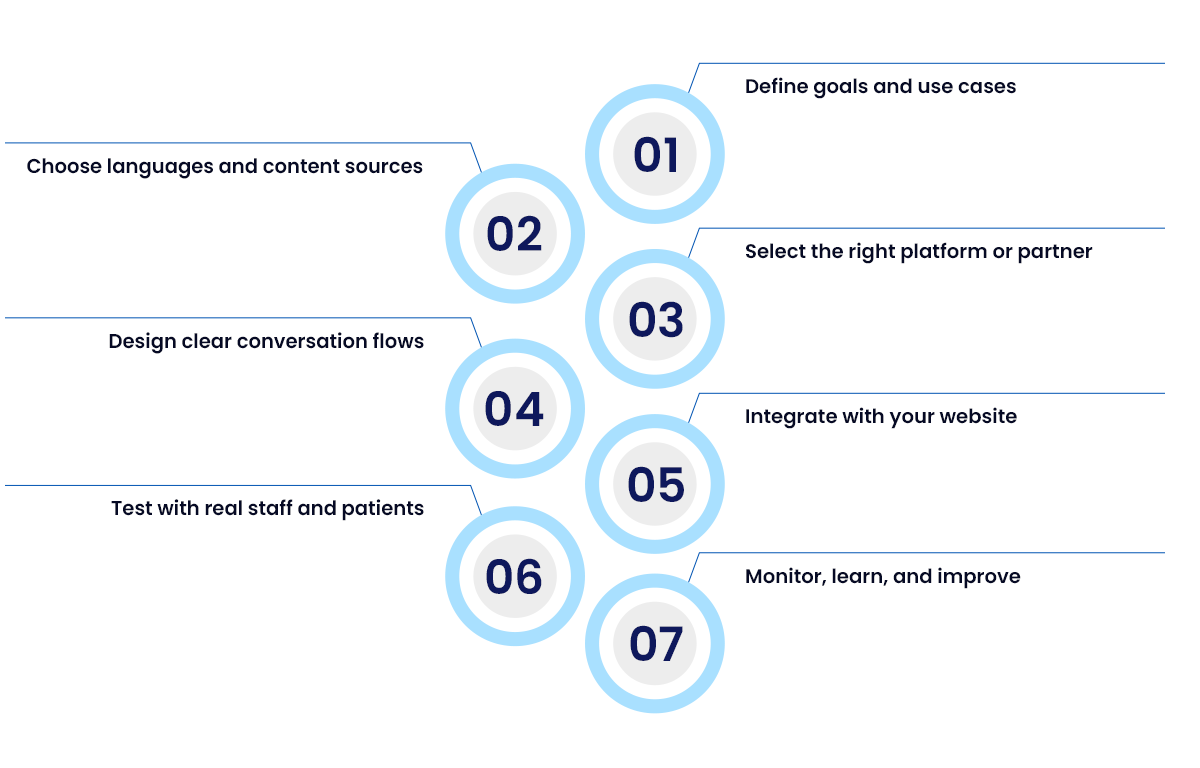
Let’s walk through a practical, business-friendly view of implementation on a website.
Step 1: Define goals and use cases
Start with a simple question: “What are the top 10 reasons people contact us?”
List those reasons—appointments, test results, insurance, directions, portal login issues, etc. Then decide which of these can be handled by a chatbot and which must always go to a human.
This simple exercise keeps your project focused and prevents scope from exploding.
Step 2: Choose languages and content sources
Next, look at your patient base. Which languages do they speak most? Local census data, claims data, and call center reports can help here, especially where many patients speak Spanish, Chinese, Arabic, or other languages.
Then, identify content sources:
- Website pages
- Patient education materials
- FAQs and printed brochures
- Internal scripts used by call center staff
These sources will feed the chatbot, but they may need rewriting into shorter, clearer answers.
Step 3: Select the right platform or partner
You can build from scratch, use a platform, or work with a vendor. The choice depends on your in-house skills, budget, and integration needs.
Important considerations:
- Healthcare compliance (HIPAA and other local regulations)
- Integration with EHR, scheduling, and patient portal
- Support for multilingual content and translation quality
- Role-based access and audit logs for safety
The point is not to chase fancy tech features. The point is to find a setup that fits your environment and can grow over time.
Step 4: Design clear conversation flows
For each use case, design a simple flow:
- How does the bot greet?
- What questions does it ask first?
- What options does it present?
- When does it escalate to a human?
Keep questions short and friendly. Avoid long blocks of text. Make it easy for the patient to switch language or ask for a human at any time.
Step 5: Integrate with your website
Usually you add the chatbot as:
- A floating chat icon
- An embedded widget on key pages (e.g., appointments, billing)
- A full page “virtual assistant” experience
Technical steps often include adding a script snippet, configuring authentication (if needed), and setting up secure connections to your internal systems.
Step 6: Test with real staff and patients
Before going live, run pilot tests. Ask front-desk staff, nurses, and billing teams to try common scenarios. Fix confusing responses, missing options, and language issues.
If possible, test with a small patient group who speaks different languages and gather feedback on clarity, tone, and trust.
Step 7: Monitor, learn, and improve
After launch, monitor:
- Top questions
- Drop-off points
- Languages used
- Escalation reasons
Use this data to adjust flows, add content, or change how the bot responds. This is not a “set and forget” project; it is an ongoing improvement loop.
How to implement a multilingual AI chatbot in a healthcare app
Many of the website steps still apply, but apps add a few extra layers.
Step 1: Decide where the chatbot lives in the app
Ask yourself: should the chatbot be visible on every screen, or only in certain sections like “Help” or “Support”?
Some providers add a persistent chat icon, while others place it in the menu next to “Appointments” or “Messages”. The choice should match how your users actually behave inside the app.
Step 2: Make use of app context
An app chatbot can access more context than a website:
- Logged-in user profile
- Past appointments and providers
- Active prescriptions
- Notification preferences
With the right permissions and privacy controls, the bot can give more tailored replies, such as “Your next visit is on Tuesday at 10 a.m. with Dr. Smith. Do you want to reschedule?”
Step 3: Handle offline and push interactions
On mobile, people might see push notifications from the bot:
- Appointment reminders
- Lab results availability (without revealing sensitive details in the notification)
- Follow-up prompts after a visit
Design flows where the notification opens directly into a relevant chat thread, continuing the conversation instead of making the user hunt for information.
Step 4: Respect privacy and security
According to security expert Alex Lekander from Cyber Insider, healthcare chatbots handling patient interactions must implement end-to-end encryption for all conversations, particularly when processing protected health information across language translation layers. "Each translation request creates additional data exposure points that require strict access controls and audit logging to maintain HIPAA compliance," he says. Healthcare apps must treat security as non-negotiable. That means:
- Clear consent for data use
- Encrypted communication between app and backend
- Strong authentication for sensitive actions (like accessing records or payments)
Make sure the chatbot never reveals private medical data to someone who is not properly authenticated, even if they hold the phone.
How can you build a multilingual AI chatbot?
There are four broad paths you can take, depending on your resources and risk tolerance.
Path 1: Use a no-code or low-code platform
Many platforms let you build basic chatbots with drag-and-drop tools, prebuilt templates, and simple integrations. This is often the fastest way to run a pilot or cover a limited set of questions.
Pros:
- Faster to start
- Lower upfront cost
- Less technical knowledge needed
Cons:
- Limited customization
- May not handle complex healthcare integrations or strict compliance
Path 2: Use APIs from large AI providers
Here, your tech team uses APIs from major AI providers to build custom chat experiences. You control more of the logic, data, and user experience, but you also take on more responsibility.
This approach suits organizations with in-house developers or a strong external partner.
Path 3: Hybrid approach with domain-specific partners
You can work with a partner that provides a healthcare-specific chatbot layer—prebuilt modules for triage, booking, reminders, and multilingual flows—on top of major AI platforms. This blends speed with domain knowledge.
The point is: you do not need to reinvent every wheel. Use what exists, and customize where it matters.
Path 4: Fully custom development
Large health systems or digital health companies sometimes build their own chatbot stack, including custom language models, routing, and integration layers. This demands serious technical investment but can give the most control and differentiation.
This path is best when you have clear long-term plans, internal AI expertise, and a strong need to tailor every part of the experience.
Why invest in a multilingual healthcare chatbot?
Here is the business case in plain terms:
- Your patients are already used to chat experiences from banks, airlines, and retail.
- A growing share does not speak native English, and language barriers are directly linked to worse experiences and outcomes.
- Healthcare chatbots are now a proven category, with global market forecasts showing strong growth over the next decade.
So the question is not “Is this trend real?”
The better question is “Where can a chatbot reduce friction in our patient journey right now?”
How to pick your first use cases
If you try to solve everything at once, the project will stall. Instead:
- Map your patient journey from first visit to follow-up.
- Highlight where people most often get confused or call for help.
- Choose one or two high-impact scenarios for your first chatbot release.
For many providers, these are:
- Appointment booking and basic FAQs for the website
- Billing and insurance questions
- Pre-visit instructions in multiple languages
When that pilot works, you can expand to more advanced flows and deeper integrations.
How Zenesys Solutions Inc can help
Zenesys Solutions Inc focuses on practical, AI-driven digital experiences for healthcare, with a strong emphasis on real-world workflows instead of just “nice demos.”
For multilingual chatbots, that usually means:
- Understanding your patient segments and language needs
- Mapping your current website and app experiences
- Identifying quick-win use cases and longer-term opportunities
- Designing clear conversation flows that match your brand and clinical policies
- Integrating with your existing systems (scheduling, portals, messaging)
- Setting up monitoring so you can see what patients ask and how the bot performs
The point is not just to add a chat bubble.
The point is to build a reliable digital assistant that respects clinical safety, reduces staff overload, and helps your patients feel guided at every step.
Add-on considerations: safety, compliance, and trust
For healthcare, trust is everything. A multilingual chatbot must earn it.
Be transparent
Make it clear that the user is talking to an AI assistant, not a doctor. Show what the bot can and cannot do.
Put safety rails in place
For emergency-like symptoms or high-risk phrases, the bot should quickly direct users to urgent care or emergency services and avoid trying to “diagnose”.
Keep humans in the loop
Give patients an easy way to reach a human agent, request a callback, or escalate the conversation.
Audit and improve regularly
Use analytics and periodic reviews to check that the bot’s answers stay aligned with current medical guidance and policies.
Bringing it all together
Simply put, a multilingual chatbot for your healthcare website and app is about reducing friction where it hurts most—access, clarity, and confidence.
Patients want clear answers, in their language, without jumping through hoops. Staff want fewer repetitive calls and more time for real care. Your leadership wants better data, better experiences, and smart use of AI that respects risk and regulation.
If you approach this as a practical tool—not a buzzword—and focus on a few high-value journeys first, a multilingual chatbot can quietly become one of the most useful helpers in your digital front door.



.webp?lang=en-US&ext=.webp)

.webp?lang=en-US&ext=.webp)